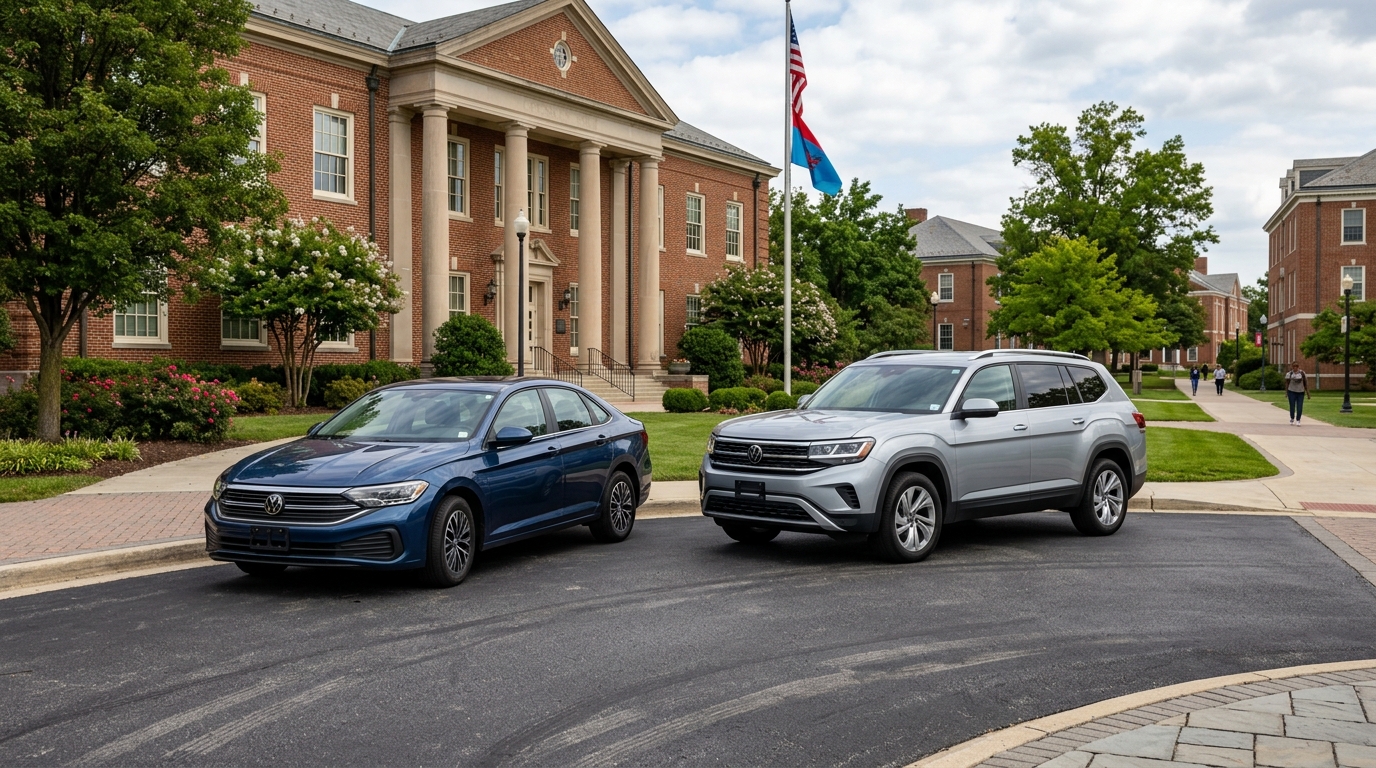
The 2026 Volkswagen Jetta S stands out as the optimal choice for college commuters driving to Delaware State University, delivering 158 horsepower, 184 lb-ft of torque, and EPA-estimated fuel economy of 29 mpg city / 40 mpg highway from its 1.5L turbocharged engine. For students or faculty needing expanded cargo capacity or all-wheel drive, the subcompact 2026 Volkswagen Taos SE 4MOTION provides about 28 cubic feet of rear cargo space and 174 horsepower while maintaining efficient daily operation.
Selecting the right vehicle for campus commuting requires balancing daily fuel expenses, cabin comfort during highway travel, and interior versatility for carrying academic supplies or athletic equipment. For drivers traveling from Milford along Route 113, the sedan design of the Jetta minimizes drag and maximizes highway range, making it exceptionally cost-effective for high-mileage schedules. The turbo engine produces its peak torque low in the RPM band, providing immediate acceleration when merging onto highway corridors without straining the powertrain.
Drivers who require additional ground clearance or variable weather capability often lean toward the crossover lineup. The Taos features an elevated seating position that improves visibility during busy morning parking navigation on campus, alongside a split-folding rear row that opens up about 66 cubic feet of maximum cargo volume. Meanwhile, faculty members or student carpools needing maximum passenger room can turn to larger options like the Atlas, which offers three rows of seating and up to 5,000 lbs of towing capacity when properly equipped.
Our showroom team at Winner Volkswagen helps every student and faculty member evaluate daily mileage patterns and cargo requirements to identify the ideal trim. You can visit our showroom on North Dupont Highway to compare cabin layouts, or call our sales desk directly at (302) 601-4091 to speak with a specialist. If you want a sportier sedan feel for weekend drives, you can also explore our new Volkswagen Jetta GLI inventory to see performance upgrades like a 228 horsepower engine and sport-tuned suspension.
Table of Contents
- What Are the Key Specs and Equipment on the 2026 Volkswagen Jetta S for DSU Commuters?
- Which 2026 Volkswagen SUV Offers the Best Balance of Size and Cargo Space for Commuters?
- Is a 2026 Volkswagen Jetta More Cost-Effective Than a VW SUV for Commuting to DSU?
- How Do Campus Parking Permits, Rules, and Placement Work at Delaware State University?
- How Does Volkswagen Factory Warranty Coverage Compare to Honda for Campus Commuters?
- What Maintenance Intervals Keep Your 2026 Volkswagen Reliable for Daily DSU Commutes?
What Are the Key Specs and Equipment on the 2026 Volkswagen Jetta S for DSU Commuters?
With an eight-speed Tiptronic® automatic transmission and front-wheel drive, the 2026 Volkswagen Jetta 1.5T S Auto SULEV delivers a smooth and efficient driving experience for DSU commuters. Starting at a base MSRP of $23,995 with a $1,275 destination charge, the entry-level trim delivers standard driver-assist safety technology, full LED exterior lighting, and digital cabin displays tailored to modern commuting demands.
Standard safety equipment on the Jetta S centers around the IQ.DRIVE® driver-assist suite, which integrates adaptive cruise control, lane keeping assist, blind-spot monitoring with rear cross-traffic alert, and forward collision warning with autonomous emergency braking. These safety systems monitor traffic movement during heavy morning transit along Dupont Highway, actively adjusting cruising distances and warning drivers of potential hazards. An auto-dimming rearview mirror and heated power side mirrors come standard, enhancing visibility during early morning classes or late evening study sessions.
Inside the cabin, the Jetta S features an 8.0-inch digital instrument cluster alongside an 8.0-inch central touchscreen infotainment display. Standard wireless phone mirroring allows seamless integration for navigation apps and media streaming without cable clutter across the center console. Dual-zone automatic climate control keeps both front passengers comfortable regardless of seasonal temperature swings, while cloth seating surfaces provide durable daily wear resistance.
Which 2026 Volkswagen SUV Offers the Best Balance of Size and Cargo Space for Commuters?
The subcompact 2026 Volkswagen Taos provides the ideal balance of overall exterior dimensions and interior cargo utility for campus commuters, offering about 28 cubic feet of cargo room behind the second row in a city-friendly footprint. Stepping up to the redesigned 2026 Volkswagen Tiguan increases cargo volume to about 34 cubic feet, while the cavernous three-row 2026 Volkswagen Atlas delivers about 21 cubic feet behind its third row and up to about 97 cubic feet with all rear seats folded flat.
Navigating campus parking structures requires a vehicle that handles tightly while offering sufficient interior room for gear. The Taos features an overall curb weight of 3,201 lbs in front-wheel drive configurations, making it quick and nimble when maneuvering into standard parking stalls. Its 1.5L turbocharged engine generates 174 horsepower and 184 lb-ft of torque, delivering EPA ratings of 28 city / 36 hwy / 31 combined mpg for low daily fuel usage.
For commuters who routinely carry large project materials, sports equipment, or carpool groups, the Tiguan expands interior volume with higher ceiling clearance and an available power liftgate. Power comes from a 2.0L turbocharged engine producing 201 horsepower and 207 lb-ft of torque, backed by a 1,500 lbs towing capacity for light utility trailers. The largest option, the Atlas, utilizes a high-output 2.0L engine with 269 horsepower and 273 lb-ft of torque, making it suitable for faculty members who tow recreational boats or travel with full seven-passenger loads.
When evaluating your current vehicle to step into a new crossover, you can use our online instant cash offer tool to get an estimated trade value before visiting campus or dealership facilities. Comparing the physical footprints of these three crossovers helps buyers select the exact balance between parking convenience and interior haul capacity.
Is a 2026 Volkswagen Jetta More Cost-Effective Than a VW SUV for Commuting to DSU?
The 2026 Volkswagen Jetta 1.5T S Auto SULEV is significantly more cost-effective than Volkswagen crossover alternatives, holding a lower base MSRP of $23,995 compared to the base Taos S at $26,500 and the base Tiguan S at $30,805. Over a multi-year academic program, the combination of a lower acquisition price, reduced destination charges of $1,275, and superior fuel economy ratings of 40 mpg highway substantially reduces total ownership costs for students and faculty.
Fuel consumption accounts for a major portion of ongoing commuter expenses. A student commuting 30 miles daily from Middletown along the Route 1 corridor will complete roughly 150 miles per week in campus transit alone. Achieving 40 mpg highway in a Jetta requires noticeably fewer fill-ups of regular unleaded fuel than an SUV averaging 25 mpg to 34 mpg highway. Over four academic years, these fuel savings accumulate alongside lower routine tire replacement costs due to the sedan's lighter curb weight.
Insurance premiums and routine wearing components like brake pads also favor lighter compact sedans. While crossovers offer higher seating positions and larger rear cargo bays, the Jetta provides about 14 cubic feet of trunk space, which easily handles three large backpacks and campus gear. For buyers who do not strictly require all-wheel drive traction or high ground clearance, the sedan structure delivers superior financial efficiency.
Our team in the flexible financing department assists students and parents with structuring terms that fit academic budgets. Laying out initial pricing against long-term fuel figures clearly demonstrates why the Jetta remains the value leader for campus commuting.
Pricing
Pricing by trim
| Feature | 1.5T S Auto SULEV | 1.5T SE Auto SULEV | 1.5T SEL Auto SULEV | 1.5T Sport Auto SULEV | 2.0T GLI Autobahn | 2.0T GLI Autobahn DSG |
|---|---|---|---|---|---|---|
| Base MSRP | $23,995 | $26,985 | $29,995 | $25,305 | $33,745 | $33,745 |
| Destination charge | $1,275 | $1,275 | $1,275 | $1,275 | $1,275 | $1,275 |
Q: How Do Campus Parking Permits, Rules, and Placement Work at Delaware State University?
Delaware State University requires all student, faculty, and staff vehicles parked on campus grounds to display a valid university parking permit registered through the official DSU Parking Portal. Commuter students are issued designated green-coded permits restricted to commuter parking lots during standard operational hours, whereas resident students receive red-coded permits tied to specific residence hall lots.
Vehicles must be registered online using valid student or employee credentials, requiring vehicle details including the vehicle identification number, make, model, trim, color, and license plate state and number. Permit fees are established annually per academic classification, with annual commuter student permits typically priced between $75 and $100 per academic year, while faculty and staff permits are calculated based on contract status or payroll deduction preferences.
When students and faculty stop by our showroom to pick up a new commuter vehicle, they often ask where to place their DSU permit hangtag; we always point out that affixing it to the lower driver-side corner of the front windshield or hanging it prominently from the rearview mirror keeps it fully visible to campus parking enforcement. Parking in unauthorized zones, blocking service drives, or failing to display a valid permit facing outward can result in campus ticketing or vehicle immobilization.
To keep your vehicle interior organized and protect carpeted floors from mud and rain during campus walks, you can browse our genuine Volkswagen accessories catalog for custom-fit all-weather floor liners and rear cargo organizers designed specifically for your model.
Q: How does Volkswagen factory warranty coverage compare to Honda for campus commuters?
Volkswagen provides a 4-year/50,000-mile bumper-to-bumper limited warranty alongside the Carefree Maintenance program covering scheduled maintenance for 2 years or 20,000 miles. In comparison, Honda offers a 3-year/36,000-mile limited warranty. Volkswagen's additional coverage year and 14,000 extra miles offer greater protection against unexpected mechanical expenses for students accumulating high commuter mileage. Buyers can explore our certified pre-owned Volkswagen inventory for models that include additional factory-backed coverage, or review our buying versus leasing options to match warranty terms with their campus stay.
Q: What type of parking permit is required for student and faculty commuters at Delaware State University?
Commuter students must apply for a green-coded commuter permit through the online DSU Parking Portal, granting access to designated commuter parking lots during campus hours. Faculty and staff members apply for an employee permit that authorizes parking in designated staff spaces across campus. Both user groups register their vehicle information digitally using official university logins.
Q: Where must parking permit decals or hangtags be placed on a vehicle at DSU?
Permit hangtags must be placed prominently on the rearview mirror with the permit number facing outward through the front windshield whenever parked on university property. If a decal is issued, it must be permanently affixed to the lower driver-side corner of the front windshield so that campus security officers can easily inspect it during lot patrols.
Q: Is the 2026 Volkswagen Jetta S more budget-friendly over four years than a compact SUV?
Yes, the 2026 Jetta 1.5T S Auto SULEV carries a base MSRP of $23,995, which is several thousand dollars lower than entry-level compact crossovers. Combined with its EPA rating of 40 mpg highway, lower insurance cost profile, and reduced tire wear, the Jetta S delivers significantly lower operational costs across a traditional four-year college degree program.
Q: What maintenance schedule should DSU commuters follow to maintain factory warranty coverage?
Commuters should perform oil and filter changes every 10,000 miles or 12 months, alongside regular tire rotations and multi-point inspections. Adhering to these intervals keeps the vehicle compliant with factory warranty terms and ensures long-term powertrain reliability. For branded automotive gear and travel accessories, owners can check our Volkswagen DriverGear gear catalog before long road trips.
Q: What Maintenance Intervals Keep Your 2026 Volkswagen Reliable for Daily DSU Commutes?
Following Volkswagen's recommended maintenance interval of 10,000 miles or 12 months keeps your engine running efficiently and preserves factory warranty protections throughout your time at Delaware State University. Key service milestones include synthetic oil and filter replacements, tire rotations to ensure even tread wear across front-wheel drive components, and brake pad inspections every 10,000 miles.
At 20,000 miles, technicians inspect the brake system, replace cabin air filters to maintain HVAC performance, and check steering and suspension components. Severe commuter usage, such as frequent stop-and-go driving or short winter trips, makes routine fluid checks essential. Every new Volkswagen also includes 24/7 Roadside Assistance during the limited warranty period, reachable directly at Volkswagen Roadside Assistance: 1-800-411-6688 for emergency towing, flat-tire assistance, or jump starts.
Our factory-trained technicians at Winner Volkswagen perform every service procedure using genuine OEM parts engineered specifically for your model. You can stop by our Dover location on North Dupont Highway, call our service center at (302) 601-4091, or reserve your next oil change using our online service scheduling tool today.