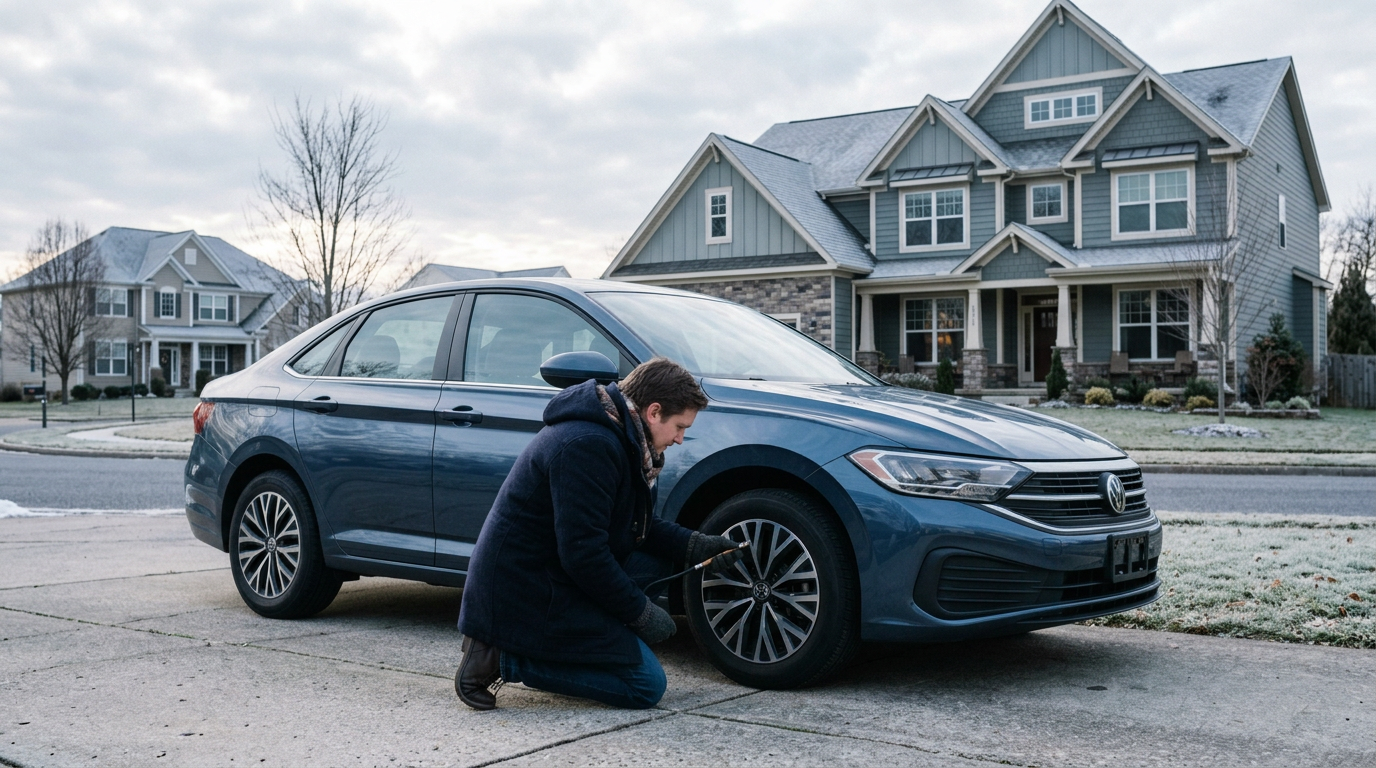
Preparing a Volkswagen for winter driving involves inspecting the 12-volt battery, checking tire tread depth and cold tire pressure, replacing worn wiper blades with winter-grade units, testing engine coolant freeze protection, and verifying that all heating and defrost systems operate correctly. Ensuring proper brake pad thickness and packing a dedicated vehicle emergency kit complete the core cold-weather preparation process.
Winter weather along the Delmarva Peninsula brings freezing temperatures, unexpected ice storms, and road salt application that demand specific vehicle preparation. DelDOT salt trucks routinely spread thousands of tons of salt across state roadways during winter events, creating challenging conditions for electrical systems, undercarriages, and rubber seals. A systematic approach to pre-winter care helps prevent unexpected breakdowns and maintains optimum vehicle performance when temperatures drop below freezing.
To get your vehicle completely winter-ready, systematic checks should focus on critical operational systems:
- 12-Volt Battery and Electrical Output: Cold temperatures slow chemical reactions inside lead-acid batteries, reducing cranking power by up to 50 percent at zero degrees Fahrenheit while the engine simultaneously requires more power to turn over cold oil.
- Tire Condition and Inflation: Ambient air pressure drops by approximately 1 PSI for every 10-degree drop in outside temperature. Inspecting tread depth ensures sufficient channeling for slush and standing water.
- Fluid Health and Freeze Protection: Engine coolant must maintain a correct water-to-antifreeze ratio to prevent freezing inside the engine block, while winter-formula windshield washer fluid prevents fluid lines from freezing solid.
- Wiper Blades and Defrost Mechanics: Heavy snow and morning frost strain wiper arms and rubber inserts. Fresh wiper blades combined with active climate defrost prevent streaking and maintain clear visibility.
Driver safety also depends on seasonal driving adjustments. Emergency management guidelines advise allowing extra following distance during freezing weather, clearing all ice from vehicle roofs before driving, and using extra caution on bridges and overpasses, which freeze much faster than roadway surfaces. If you need local assistance preparing your vehicle for sub-freezing conditions, stop by our showroom address on Dupont Highway or give our team a quick call to speak with our certified service advisors.
Table of Contents
- What Key Maintenance Items Are Included in a Pre-Winter Vehicle Inspection?
- How Does Volkswagen 4Motion All-Wheel Drive Perform in Snow and Ice?
- What Is the Stopping Distance Difference Between Winter Tires and All-Season Tires on Ice?
- What Cold Weather Comfort and Defrost Features Are Included in Volkswagen Models?
- Common Questions About Volkswagen Winter Care and Cold Weather Driving
- What Local Volkswagen Loyalty Offers and Winter Service Can Dover Drivers Access?
What Key Maintenance Items Are Included in a Pre-Winter Vehicle Inspection?
A comprehensive pre-winter vehicle inspection covers a multi-point check of the battery's cold-cranking capacity, brake system components, tire tread and inflation, engine coolant protection levels, wiper blade condition, and exterior lighting systems. Certified technicians measure critical tolerances and test electrical health to ensure your vehicle starts reliably and stops safely in sub-freezing weather.
During a professional multi-point winter evaluation, certified technicians systematically inspect every major mechanical and safety component:
- Battery Health and Charging System Test: Technicians measure cold cranking amps and output voltage from the 140-amp alternator to ensure the battery can withstand high electrical demands from seat heaters, defrosters, and headlights during winter starts.
- Brake System Diagnostics: Inspection includes checking front and rear brake disc thickness, pad remaining material, caliper sliding action, and brake fluid moisture levels. Moisture in brake fluid can lower its boiling point and degrade braking performance in freezing weather.
- Tire Pressure and Tread Depth Evaluation: Technicians check that tires have at least 4/32 inches of tread depth for adequate snow traction and adjust tire inflation to match the specification listed on the driver-side door pillar. Our service advisors frequently see tire pressure warning lights triggered during Delaware's first cold snap as falling temperatures naturally lower tire pressure.
- Coolant and Antifreeze Strength: Testing the engine coolant with a refractometer confirms that the fluid's freeze point is rated to at least -25 degrees Fahrenheit, protecting the radiator and engine block against thermal cracking.
- Wiper Blade and Lighting Audit: Inspecting wiper rubber for tears or splitting ensures effective clearing of road splash, while testing all exterior LED and halogen bulbs guarantees proper visibility to other motorists.
Whether you drive a compact sedan like the Jetta or are exploring a larger family vehicle like our new Volkswagen Atlas Cross Sport inventory, keeping up with seasonal maintenance protects your investment. You can easily schedule your pre-winter checkup using our online service scheduling tool.
How Does Volkswagen 4Motion All-Wheel Drive Perform in Snow and Ice?
Volkswagen 4Motion® all-wheel drive optimizes winter traction by operating primarily in front-wheel drive under normal conditions to conserve fuel and automatically redistributing engine torque to the rear axle within milliseconds when sensors detect wheel slip. This proactive torque distribution gives drivers immediate stability and control on snow-covered roads and icy patches.
The electro-hydraulic 4Motion® system continuously gathers data from wheel speed sensors, steering angle inputs, throttle position, and engine torque outputs. In ideal driving conditions, the system directs nearly all engine power to the front wheels. When accelerating onto a slick roadway or navigating slush on Route 1, an electro-hydraulic oil pump engages a multi-plate clutch pack to transfer up to 50 percent of available engine torque to the rear wheels before significant front-wheel spin can occur.
Key operational features of 4Motion® for winter conditions include:
- Proactive Torque Coupling: Rather than waiting for total traction loss, 4Motion® engages preemptively during hard acceleration or steering maneuvers on low-grip surfaces.
- Integration with Electronic Stability Control: The system works alongside Electronic Stability Control (ESC) and Electronic Differential Lock (EDL) to apply selective braking forces to individual spinning wheels, transferring power laterally across the axle to wheels with available grip.
- Customizable Driving Modes: Models equipped with driving mode selection allow drivers to select specialized snow settings that soften throttle response and adjust transmission shift points in the 8-speed automatic with Tiptronic® transmission to prevent traction loss on packed snow.
For compact crossover drivers operating a model like the Tiguan 2.0T SE with available 4MOTION®, the powertrain generates 201 hp and 207 lb-ft of torque, delivering confident traction while maintaining an EPA-estimated 26 city / 34 hwy MPG. Drivers seeking maximum winter capability can explore our selection of certified pre-owned Volkswagen models equipped with all-wheel drive, or personalize their current vehicle for cold-weather utility with original accessories from our Volkswagen DriverGear items collection.
What Is the Stopping Distance Difference Between Winter Tires and All-Season Tires on Ice?
On packed ice or hard-packed snow at 30 mph, dedicated winter tires can reduce stopping distances by up to 30 feet—or roughly two full car lengths—compared to standard all-season tires. This dramatic reduction occurs because winter tire rubber compounds remain flexible in sub-zero temperatures and feature thousands of microscopic traction sipes that grip slick ice surfaces.
All-season tire rubber compounds begin to stiffen when temperatures drop below 45 degrees Fahrenheit, transforming into a hard surface that struggles to conform to road irregularities. In contrast, dedicated winter tires utilize hydrophilic silica-infused rubber compounds engineered specifically to remain soft and pliable in extreme cold.
| Performance Metric | Standard All-Season Tires | Dedicated Winter Tires | Performance Advantage |
|---|---|---|---|
| Rubber Flexibility Threshold | Hardens below 45°F | Stays flexible below -20°F | Superior cold-weather surface contact |
| Braking Distance on Ice (30-0 mph) | Approximately 120 feet | Approximately 90 feet | Stops up to 30 feet shorter |
| Tread Pattern Engineering | Moderate block gaps, basic siping | High-density 3D sipes, deep grooves | Enhanced snow packing and slush evacuation |
| Lateral Cornering Traction | Reduced lateral grip on packed ice | High lateral traction control | Improved cornering stability on slick curves |
When driving on icy suburban routes near Middletown, having proper winter tires provides critical safety margins during emergency stopping situations. The deep circumferential grooves in winter tread designs rapidly channel away slush and melting ice surface water, preventing hydroplaning and maintaining direct rubber contact with the asphalt.
If you are planning to upgrade your vehicle's winter equipment or consider trading in your current car for an all-wheel-drive model before severe weather hits, start by using our online trade-in valuation tool to receive an estimate of your current vehicle's worth.
What Cold Weather Comfort and Defrost Features Are Included in Volkswagen Models?
Volkswagen models incorporate advanced winter comfort and defrost technologies, including multi-stage heated front and outer rear seats, a heated leather steering wheel, heated power side mirrors, heated windshield washer nozzles, and remote vehicle start via key fob or smartphone app. These integrated features clear ice quickly and keep the passenger cabin warm during sub-freezing weather.
Modern Volkswagen interiors are engineered to eliminate cold-weather driving friction through automated thermal systems:
- Remote Vehicle Start: Drivers can pre-condition cabin temperature, activate defrosters, and trigger heated seats remotely using the myVW mobile app or key fob before stepping outside.
- Climate Coat Heated Windshield Technology: Available on select models, this system utilizes a micro-thin conductive layer sandwiched within the windshield glass to melt frost and ice rapidly without visible filament wires obstructing driver vision.
- Heated Side Mirrors and Washer Nozzles: Power heated side mirrors automatically melt frost to restore rearward visibility, while heated washer nozzles prevent washer fluid from freezing inside the delivery jets during highway travel.
- Multi-Zone Automatic Climate Control: Climatronic® dual-zone or tri-zone systems monitor cabin humidity and automatically balance airflow between the footwells and windshield to keep windows fog-free while maintaining driver warmth.
- Heated Seating and Steering Wheel Controls: Multi-stage heated front seats and available outer rear heated seats provide rapid surface warming, while the heated steering wheel ensures comfortable hand placement without wearing bulky winter gloves.
To support your next vehicle purchase and take full advantage of cold-weather comfort features across our model lineup, you can complete our secure online credit application from home to review personalized payment pathways.
Common Questions About Volkswagen Winter Care and Cold Weather Driving
Q: Why does my tire pressure monitoring system (TPMS) light turn on during cold mornings?
Tire pressure drops by approximately 1 PSI for every 10-degree decrease in outside ambient temperature. When overnight temperatures plunge during Delaware winter cold snaps, the pressure inside your tires decreases naturally, triggering the TPMS warning light on your dashboard. To resolve this, check tire pressure when the tires are cold using a pressure gauge and inflate them to the recommended pressure listed on the tire specification label on the driver's door pillar, then reset the TPMS through your infotainment display.
Q: Does my Volkswagen manufacturer warranty cover winter towing and roadside emergencies?
Every new Volkswagen includes complimentary 24-Hour Roadside Assistance coverage for 3 years or 36,000 miles, providing 24/7/365 assistance for flat tires, battery jump-starts, lock-out service, fuel delivery, and towing to the nearest authorized dealership. Certified Pre-Owned models also receive 2 years or 24,000 miles of roadside coverage. If you need immediate roadside towing or emergency help, contact Volkswagen Roadside Assistance at (800) 411-6688 for manufacturer-backed support with genuine parts.
Q: What engine coolant protection level does my Volkswagen require for winter?
Volkswagen engines require official G12evo or G13 pink/purple coolant mixed with distilled water to maintain optimal freeze and corrosion protection. Pre-winter testing should confirm that your coolant maintains a freeze protection threshold of at least -25 degrees Fahrenheit to prevent engine block damage or radiator freezing during severe winter storms. You can review detailed warranty and maintenance guidelines in our certified pre-owned FAQ section or consult your vehicle owner's manual.
Q: How should I care for my vehicle's paint and underbody during salt season?
Delaware road crews apply heavy amounts of rock salt and liquid brine during ice storms, which accelerates underbody metal corrosion and dulls paint clear coats if left untreated. Washing your vehicle regularly during winter—paying special attention to high-pressure underbody rinsing—removes corrosive salt accumulation from brake lines, suspension components, and exhaust systems. Applying a fresh coat of protective wax or paint sealant before winter provides an added barrier against road chemicals.
Q: What emergency supplies should I carry in my vehicle during Delaware winters?
Delaware emergency management officials recommend packing a dedicated winter emergency kit containing heavy blankets, extra thermal clothing, a high-lumen flashlight, extra batteries, a portable phone power bank, compact jumper cables, a collapsible snow shovel, an ice scraper with a brass or rigid blade, non-perishable snacks, bottle water, and a bag of sand or cat litter for tire traction on ice. Beyond providing vehicle safety guidance, our team actively supports local community health and safety through initiatives like the community initiatives program.
Q: Where can I find factory maintenance schedules for my specific Volkswagen model?
Factory-recommended maintenance schedules, fluid capacities, and VIN-specific service intervals are detailed in your vehicle owner's manual and within the myVW mobile application. For complete details regarding our dealership service amenities, shuttle options, and certified service procedures, you can read more about our dealership and our factory-trained service department.
What Local Volkswagen Loyalty Offers and Winter Service Can Dover Drivers Access?
Dover drivers preparing for cold weather can access certified winter service, complimentary multi-point vehicle inspections, and exclusive customer loyalty incentives at Winner Volkswagen. Returning customers visiting our facility can ask our service and sales team about our $500 Winner Loyalty Discount toward eligible vehicle upgrades or replacement purchases.
Our dealership offers complete cold-weather support to keep your vehicle operating reliably all winter long:
- Factory-Certified Technicians: Our service department utilizes specialized Volkswagen diagnostic tools, computer software updates, and genuine OEM parts designed specifically for your model.
- Genuine OEM Winter Accessories: Protect your vehicle's interior carpet from slush and salt brine with custom-fit Monster Mats® all-weather rubber floor liners, mudguards, and heavy-duty trunk cargo liners available through our Volkswagen accessory catalog.
- Convenient Service Amenities: Enjoy convenient online scheduling, complimentary multi-point inspections, and local shuttle services during your maintenance appointment.
To get your vehicle ready for freezing temperatures or to explore our complete inventory of new and pre-owned winter-ready vehicles, visit our service center address at 1387 N Dupont Hwy, Dover, DE 19901, or speak directly with our team by calling (302) 601-4091 today.
© 2026 Winner Volkswagen. All rights reserved.