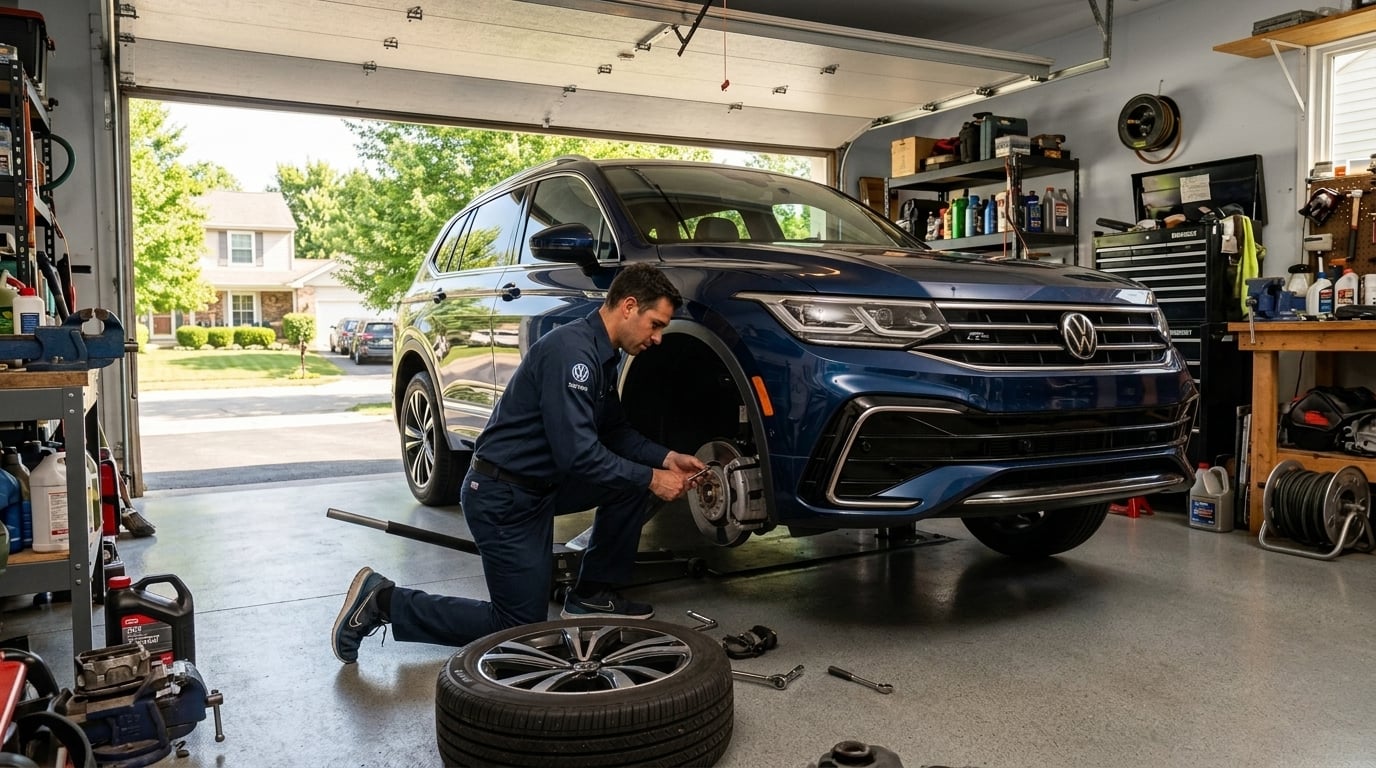
Essential summer maintenance for a Volkswagen requires a comprehensive air conditioning system inspection, a 12V battery conductance test, cabin air filter replacement, and a coolant level check. Mid-Atlantic heat severely accelerates battery fluid evaporation and taxes climate control components. Servicing these key systems ensures reliable cabin cooling, preserves electrical stability, and prevents roadside breakdowns during peak summer temperatures.
Maintaining peak vehicle health during humid summer months involves several interconnected systems. Volkswagen vehicles operate with high-precision engineering standards, meaning small maintenance oversights can rapidly compound under thermal stress. Scheduled maintenance checks focus heavily on the cooling loop, ensuring engine coolant retains the proper boiling point protection and that radiator cooling fans engage properly at high operating temperatures. Drive belts powering the water pump and air conditioning compressor must also be inspected for micro-cracks or tension loss, which can cause slipping under high electrical and mechanical loads.
Tire pressures demand increased attention when summer heat sets in. For every 10-degree rise in ambient temperature, tire pressure increases by approximately one pound per square inch. Running on improperly inflated tires during long highway trips on sun-baked asphalt increases tread wear and risks sudden blowouts. Checking inflation levels when tires are cold ensures proper contact patches and balanced handling.
Drivers bringing their vehicles in after long summer trips frequently ask about subtle cooling delays before realizing their battery and air conditioning systems are working under maximum load. Factory-trained technicians review system diagnostics to catch low refrigerant charge levels or reduced battery cranking power before components fail completely. When you need expert care, check driving directions to our Dover location, give our service team a quick call, or reserve your spot directly through our online service scheduling portal. For owners managing electric models, maintaining battery thermal regulation systems is equally critical, whether driving an ID.4 or exploring the versatile Volkswagen ID. Buzz.
Table of Contents
- Why Does Summer Heat Drain a Volkswagen 12V Battery and Is an AGM Battery Better?
- What Is the Difference Between R134a and R1234yf Refrigerants in Volkswagen AC Systems?
- How Do You Identify AC Symptoms, Clean Clogged Evaporator Drain Tubes, and Replace Cabin Filters?
- Where Can EV Drivers Find Public Charging Stations Around Dover for Summer Trips?
- Common Questions About Volkswagen Summer AC and Battery Care
- Schedule Certified Volkswagen Summer Service
Why Does Summer Heat Drain a Volkswagen 12V Battery and Is an AGM Battery Better?
Intense summer temperatures degrade a Volkswagen 12V battery faster than winter cold because ambient engine bay heat accelerates electrolyte evaporation, speeds up internal grid corrosion, and causes rapid self-discharge. Upgrading to an Absorbent Glass Mat ( AGM battery) provides significantly better heat resistance, faster recharge rates, and superior durability for vehicles equipped with start-stop technology.
While drivers traditionally worry about cold winter mornings, excessive heat is the leading physical cause of premature battery failure. Beneath the hood of a compact SUV like the 2.0T S trim Tiguan, internal temperatures can easily exceed 140 degrees Fahrenheit during stop-and-go driving. Heat causes the liquid electrolyte solution inside a standard flooded lead-acid battery to evaporate slowly, exposing the internal lead plates to air and causing irreversible sulfation. Over time, internal grid structures corrode, diminishing the battery's ability to hold a charge and leaving drivers stranded without warning.
Modern Volkswagen models place high demands on the 12V electrical infrastructure. Vehicles equipped with energy-saving engine start-stop technology, advanced driver-assist sensors, and multi-zone automatic climate control cycle the battery far more aggressively than older vehicles. Standard lead-acid batteries struggle under these rapid charge and discharge cycles, especially when ambient temperatures remain elevated for extended periods.
An AGM battery addresses these vulnerabilities through superior internal construction. Instead of free-flowing liquid acid, an AGM battery holds the electrolyte liquid suspended in micro-fiberglass mesh separators squeezed tightly between pure lead plates. This design delivers key operational advantages for Volkswagen owners:
- Enhanced resistance to vibration and thermal shock caused by hot summer road surfaces
- Slower self-discharge rates when the vehicle remains parked in direct sunlight
- Up to three times the cycle life of traditional flooded lead-acid batteries
- Faster charge acceptance from the alternator during short suburban commutes
What Is the Difference Between R134a and R1234yf Refrigerants in Volkswagen AC Systems?
The primary difference between R134a and R1234yf refrigerants in Volkswagen vehicles lies in chemical composition and environmental impact: R134a is an older hydrofluorocarbon with a high global warming potential, whereas R1234yf is a modern hydrofluoroolefin engineered to break down rapidly in the atmosphere. Newer Volkswagen models utilize R1234yf to comply with environmental standards while maintaining rapid cabin cooling efficiency.
Refrigerant serves as the chemical working fluid within your vehicle's climate control system, carrying heat out of the passenger compartment and discharging it through the condenser coil behind the front grille. Older models manufactured prior to the mid-2010s relied on R134a. While highly effective at thermal transfer, R134a carries a global warming potential rating over 1,400 times higher than carbon dioxide. The industry-wide transition to R1234yf reduced that environmental rating to less than 1, establishing a far more sustainable standard for modern auto manufacturing without sacrificing cooling speed or system performance.
| Refrigerant Spec | R134a Refrigerant | R1234yf Refrigerant |
|---|---|---|
| Chemical Classification | Hydrofluorocarbon (HFC) | Hydrofluoroolefin (HFO) |
| Global Warming Potential (GWP) | 1,430 | < 1 |
| Atmospheric Lifetime | 14 Years | 11 Days |
| VW Model Compatibility | Older Model Years | Current Production Models |
| System Operating Pressure | Medium-High | High-Precision Variable |
Recharging a modern Volkswagen climate control system using a store-bought DIY canister poses serious risks to system hardware. Modern vehicles use variable-displacement AC compressors controlled by delicate internal control valves. DIY charging cans rely on crude pressure gauges that measure ambient low-side pressure, which does not accurately reflect actual refrigerant volume in variable-displacement systems.
Attempting a DIY recharge often leads to severe mechanical issues:
- Overfilling the system with refrigerant locks the compressor and causes premature clutch or internal control valve failure
- Introducing seal-conditioner additives found in retail cans can clog expansion valves and destroy internal compressor seals
- Introducing air or moisture during canister attachment creates hydrofluoric acid inside the lines, corrupting internal aluminum surfaces
Professional climate service uses dedicated recovery and charging stations to pull a deep vacuum, evacuate moisture, test for leaks, and recharge the exact mass of R1234yf or R134a specified by factory engineers. When upgrading your vehicle's climate setup, browse genuine Volkswagen accessories and parts, get directions to our facility, or review our buying versus leasing options to understand total vehicle ownership benefits.
How Do You Identify AC Symptoms, Clean Clogged Evaporator Drain Tubes, and Replace Cabin Filters?
Identifying early climate control symptoms involves watching for lukewarm vent output, reduced fan volume, unusual compressor clicking noises, or foul mildew odors when starting the car. Addressing these issues requires clearing blocked evaporator condensate drain lines, inspecting compressor belts, and replacing clogged cabin air filters to maintain proper system pressure and airflow.
A major source of summer AC complaints stems from clogged evaporator drain tubes. As the evaporator core cools incoming outside air, moisture condenses on its outer fins. This water drips into an evaporator housing tray and drains out underneath the vehicle through a small rubber drain grommet located on the engine firewall. Agricultural dust and fine organic debris along rural routes in Denton can collect inside this drain passage, forming a dense mud plug.
When the drain tube clogs, condensation backs up inside the HVAC housing box under the dashboard. Owners will notice a wet passenger-side carpet, humid air blowing from the vents, or a heavy damp smell. Service technicians safely elevate the vehicle, locate the rubber firewall valve, and clear trapped debris using a flexible clearing tool and low-pressure compressed air to restore free drainage.
Preventing airflow restrictions requires regular cabin air filter maintenance. The cabin filter sits inside the climate housing, trapping dust, pollen, and road debris before air reaches the blower motor and evaporator core.
Key cabin air filter considerations include:
- Replacement intervals should occur every 15,000 to 30,000 miles, or at least annually
- A completely clogged filter starves the blower motor, causing electrical overheating and thermal resistor failure
- Restricted airflow reduces evaporator heat transfer, potentially causing the evaporator core to ice over and block airflow entirely
- Premium activated-carbon filters neutralize road odors and smog particles alongside particulate filtration
Where Can EV Drivers Find Public Charging Stations Around Dover for Summer Trips?
Drivers seeking public EV charging in Dover can access Level 2 and DC fast-charging locations concentrated along primary commercial corridors, state government office complexes, and major retail hubs near Route 1. Utilizing these high-speed chargers keeps electric models like the 2026 Volkswagen ID.4 topped off during hot summer travel without disrupting battery thermal management systems.
High ambient temperatures affect electric vehicle operation differently than traditional internal combustion engine vehicles. In models like the 2026 Volkswagen ID.4, hot summer weather requires the vehicle to run active liquid-cooling loops to keep the high-voltage lithium-ion battery within its ideal operating temperature window (typically between 68 and 86 degrees Fahrenheit). When driving at high speeds along Route 1 in summer heat, the vehicle simultaneously powers cabin air conditioning and battery thermal management, slightly increasing energy consumption per mile.
Public charging availability across key regional travel corridors allows electric vehicle owners to travel confidently during summer heatwaves. DC fast-charging stations located near highway corridors enable rapid top-offs, bringing an ID.4 battery from 10 percent to 80 percent charge in approximately 30 minutes under normal operating conditions. Utilizing Level 2 chargers at municipal centers or retail plazas while shopping or dining provides steady maintenance charging without thermal stress.
To preserve range and charging speeds in summer:
- Pre-condition the vehicle cabin while plugged into a charger before departing to conserve battery power on the road
- Utilize built-in navigation to route to fast chargers, allowing the vehicle to optimize battery temperature for maximum intake speeds
- Park in shaded areas or garage structures whenever possible to minimize thermal load on the standing battery pack
Enhance your electric driving experience by browsing OEM Volkswagen parts and accessories, or contact our service team directly after checking how to find directions to our service facility.
Common Questions About Volkswagen Summer AC and Battery Care
Q: How does hot weather cause a Volkswagen AC compressor to fail?
Extreme heat forces the AC compressor to run continuously under high system pressures. If refrigerant levels are low due to a minor pinhole leak, the oil carried by the refrigerant fails to circulate properly, depriving internal compressor pistons of vital lubrication. Combined with a slipping belt or a failing radiator cooling fan that cannot reduce high-side head pressures, the compressor overheats, experiences internal mechanical scuffing, and eventually seizes completely.
Q: Can a weak 12V battery cause my climate control system to blow warm air?
Yes, modern Volkswagen vehicles utilize smart energy management modules that monitor battery health continuously. If the battery voltage drops below target parameters due to heat-induced internal resistance, the control module may intentionally shed non-essential electrical loads. To protect engine starting capability, the vehicle may limit blower fan speeds or temporarily disengage the air conditioning compressor clutch, resulting in warm vent air during idle conditions.
Q: How do I know if my Volkswagen's AC system has a refrigerant leak?
The earliest indicator of a refrigerant leak is a gradual decline in cooling performance, where air feels cool rather than cold. You may also notice an audible hissing sound coming from behind the center dashboard vents when the AC engages. Visually, technicians look for wet, oily residue collecting around AC line fittings, the condenser face, or pressure sensors, as compressor oil leaks out alongside escaping refrigerant gas.
Q: Why does my Climatronic system automatically switch to recirculation mode in hot weather?
Volkswagen's Climatronic automatic climate control uses ambient temperature and humidity sensors to cool the cabin as efficiently as possible. When outside temperatures are extreme, cooling hot exterior air requires maximum energy. Switching to recirculation mode pulls air from inside the passenger cabin—which is already partially cooled—reducing the thermal load on the evaporator, saving engine power, and cooling the interior much faster.
Q: Is it necessary to reprogram the car when installing a new battery?
Yes, modern Volkswagen vehicles equipped with start-stop technology or intelligent energy management systems require battery adaptation coding during replacement. Using factory diagnostic software, technicians update the battery management module with the new battery's chemistry type ( AGM battery vs flooded), amp-hour capacity, and brand. This resets the charging algorithm, ensuring the alternator charges the new battery at correct voltage levels without overcharging.
Support community health by learning about our community initiatives, explore options via certified pre-owned ownership benefits, or learn more about our team and dedication to quality service.
Schedule Certified Volkswagen Summer Service
Proactive summer maintenance protects your vehicle's critical components from the destructive effects of heat, safeguarding your air conditioning compressor, preserving 12V battery lifespan, and keeping cabin air clean. Addressing minor system warning signs early prevents costly emergency repairs and ensures your vehicle delivers dependable performance all summer long. Factory-trained technicians bring specialized diagnostic tools, genuine OEM replacement parts, and exact engineering specifications to every service visit.
Taking care of your vehicle is straightforward and convenient. You can view our Dover service center address to plan your visit or connect with our service advisors directly at (302) 601-4091. Schedule your summer maintenance checkup today to enjoy cool, worry-free driving through every summer heatwave.
© 2026 Winner Volkswagen. All rights reserved.